Field note
A new locality for Magnolia unicarmensis and Magnolia guatapensis in Río Verde de los Henaos, Sonsón
The La Honda forest continues south along the Central Cordillera, and both magnolias go with it.
Until now, vereda La Honda in El Carmen de Viboral was the southernmost published point for two magnolias of conservation concern in eastern Antioquia. Magnolia unicarmensis A.F.Montoya-López & C.Bota-Sierra was described from the forest between vereda San Juan (La Unión) and La Honda, and had been published only from there. Its authors proposed it as Critically Endangered, but it has no official category yet (Montoya-López & Bota-Sierra, 2023; MADS, 2024). Magnolia guatapensis (Lozano) Govaerts, an endemic of Antioquia listed as Endangered both nationally and globally (Calderón et al., 2016; MADS, 2024), reached its southern limit at La Honda, about 45 km south of its previously known populations (Montoya-López, 2025).
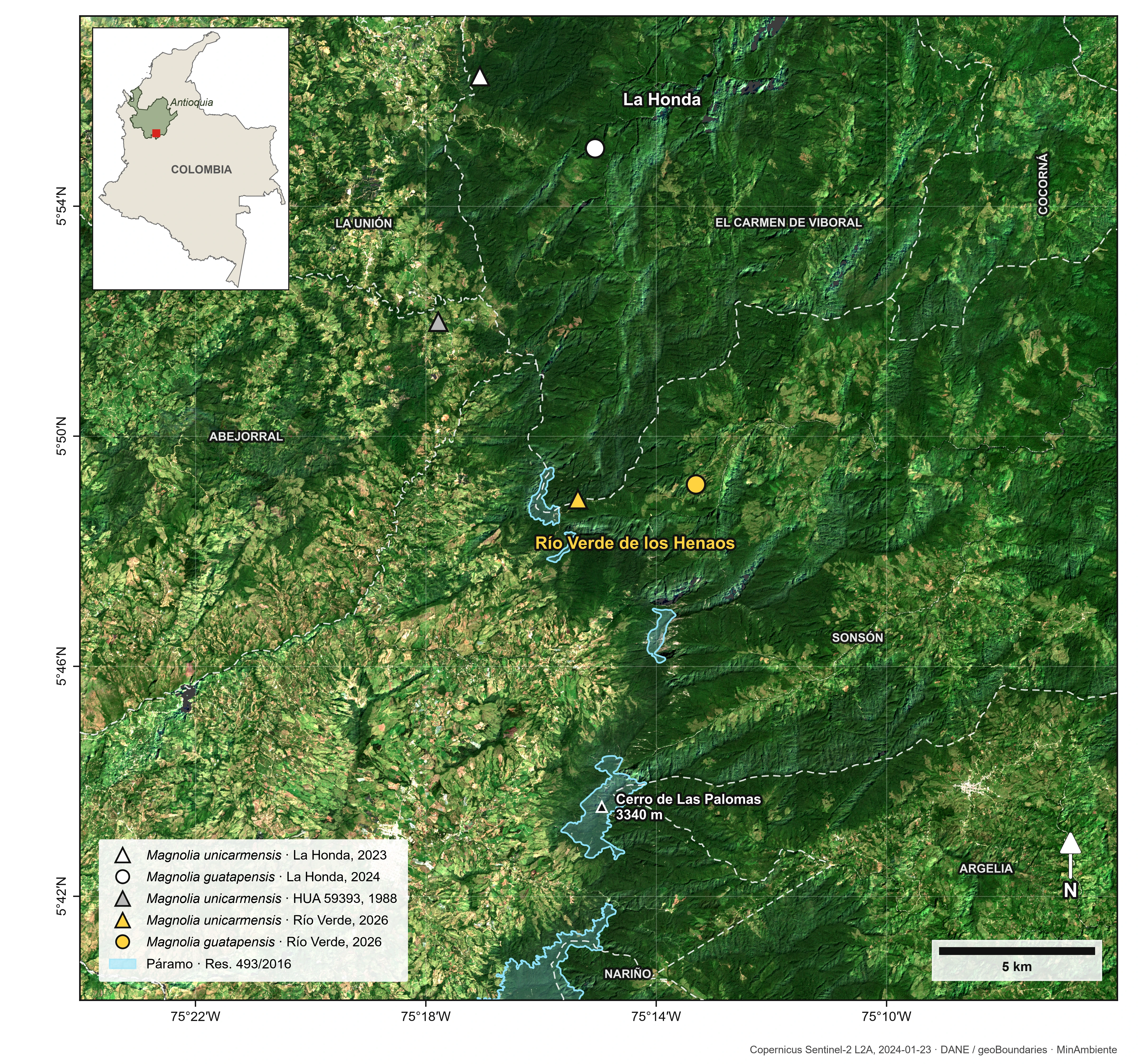
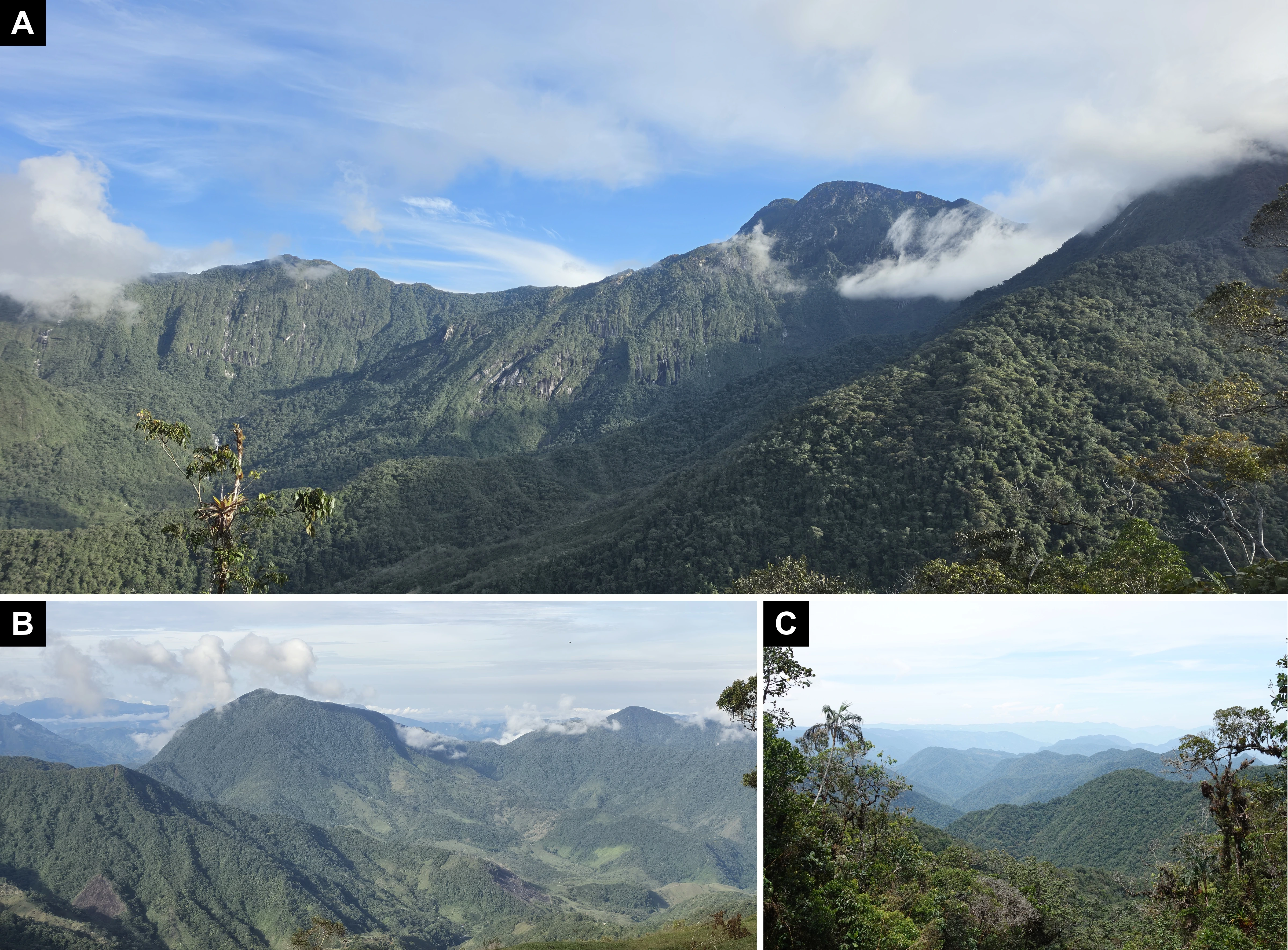
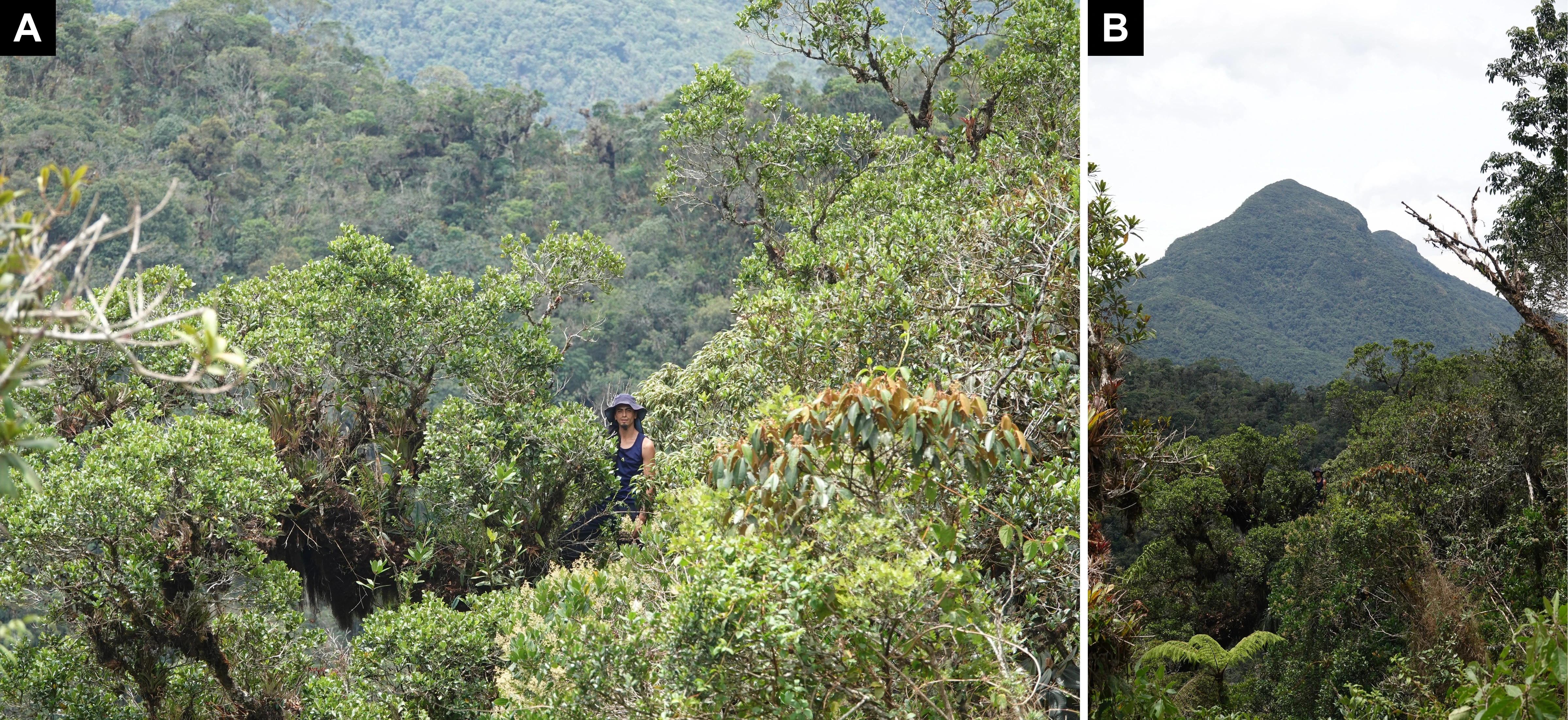
On 25 September 2026 we found both species south of La Honda, along the new road from Río Verde de los Henaos (Sonsón) through the Páramo sector toward vereda Popal. The forest along this road is continuous with the La Honda forest, running southward along the Central Cordillera (Figure 1). The records show that the two magnolias are not confined to La Honda. They follow the same forest south (Figure 2).
Records
Magnolia unicarmensis A.F.Montoya-López & C.Bota-Sierra
New record. COLOMBIA — Antioquia • Sonsón, Río Verde de los Henaos, new road from the Páramo sector toward vereda Popal, at the road edge; 05°48.906′N, 075°15.360′W; 2,699 m a.s.l.; 25 Sep. 2026; Y. Orozco, M.J. Alcibíades & A. Montoya-López obs.; photographic record, no herbarium specimens deposited.
Three adult trees stood beside the road, bearing flower buds, open flowers and fruits at the same time.
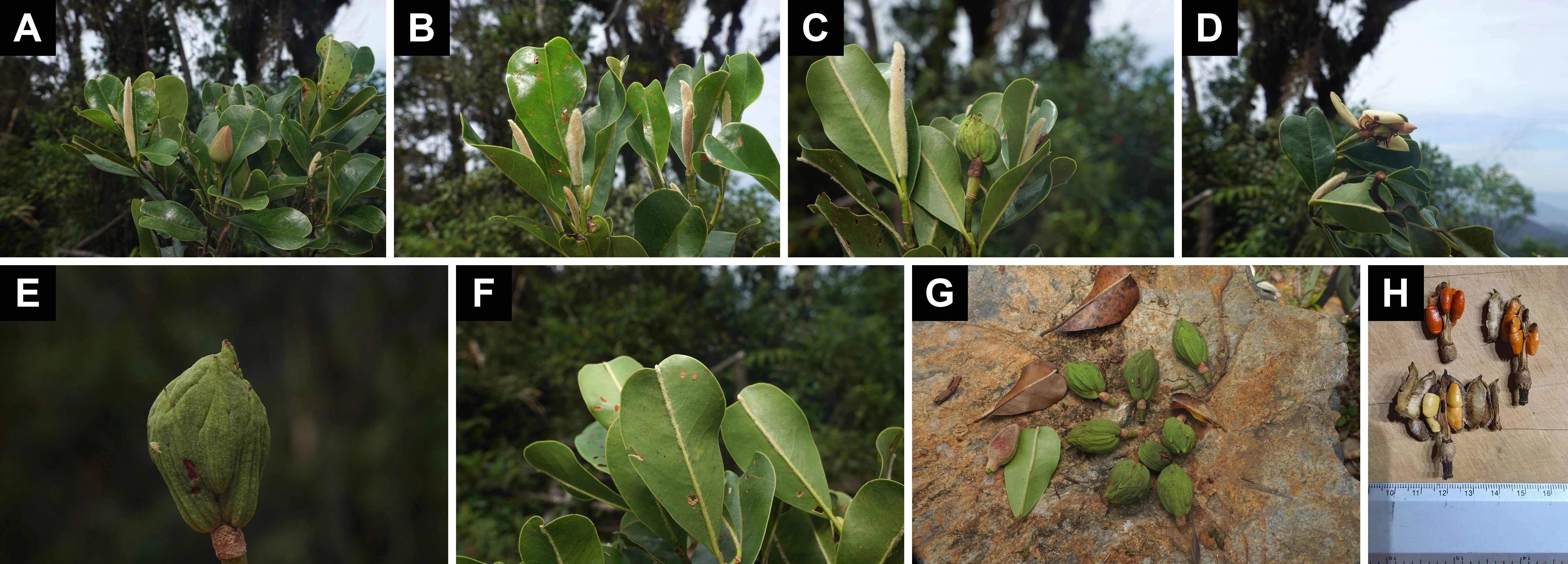
Identification. The trees match the protologue (Montoya-López & Bota-Sierra, 2023). The leaf blades are small and obovate, with a cuneate base and an emarginate apex, into which the midvein extends as a small pubescent prolongation. The lamina lacks prefoliation marks, and the abaxial surface is woolly only along the midvein. The stipules are golden woolly, and the fruits are ellipsoid, glabrous and lemon green with black spots on the carpel ridges. Glabrous fruits, golden woolly stipules and the absence of prefoliation marks separate it from M. coronata, the most similar species (Figure 3).
Remarks. The Río Verde locality is about 14 km south-southeast of the type locality and slightly higher than it (2,699 vs. 2,640 m a.s.l.). It is not, however, the first collection of the species outside the type area. A specimen gathered on 8 November 1988 at km 23.5 of the La Unión–Sonsón road, at 2,300 m (Zarucchi 7275, HUA 59393), was redetermined as M. unicarmensis by H. David in November 2023, although GBIF still lists it as M. coronata (GBIF.org, 2026; HUA, 2026). Flowers and fruits were present together in late September, which agrees with the August–September phenology reported in the protologue.
Magnolia guatapensis (Lozano) Govaerts
New record. COLOMBIA — Antioquia • Sonsón, Río Verde de los Henaos, new road from the Páramo sector toward vereda Popal, at the road edge; 05°49.162′N, 075°13.310′W; 1,881 m a.s.l.; 25 Sep. 2026; Y. Orozco, M.J. Alcibíades & A. Montoya-López obs.; photographic record, no specimens collected.
Three adult trees stood beside the road, one of them bearing fruit.
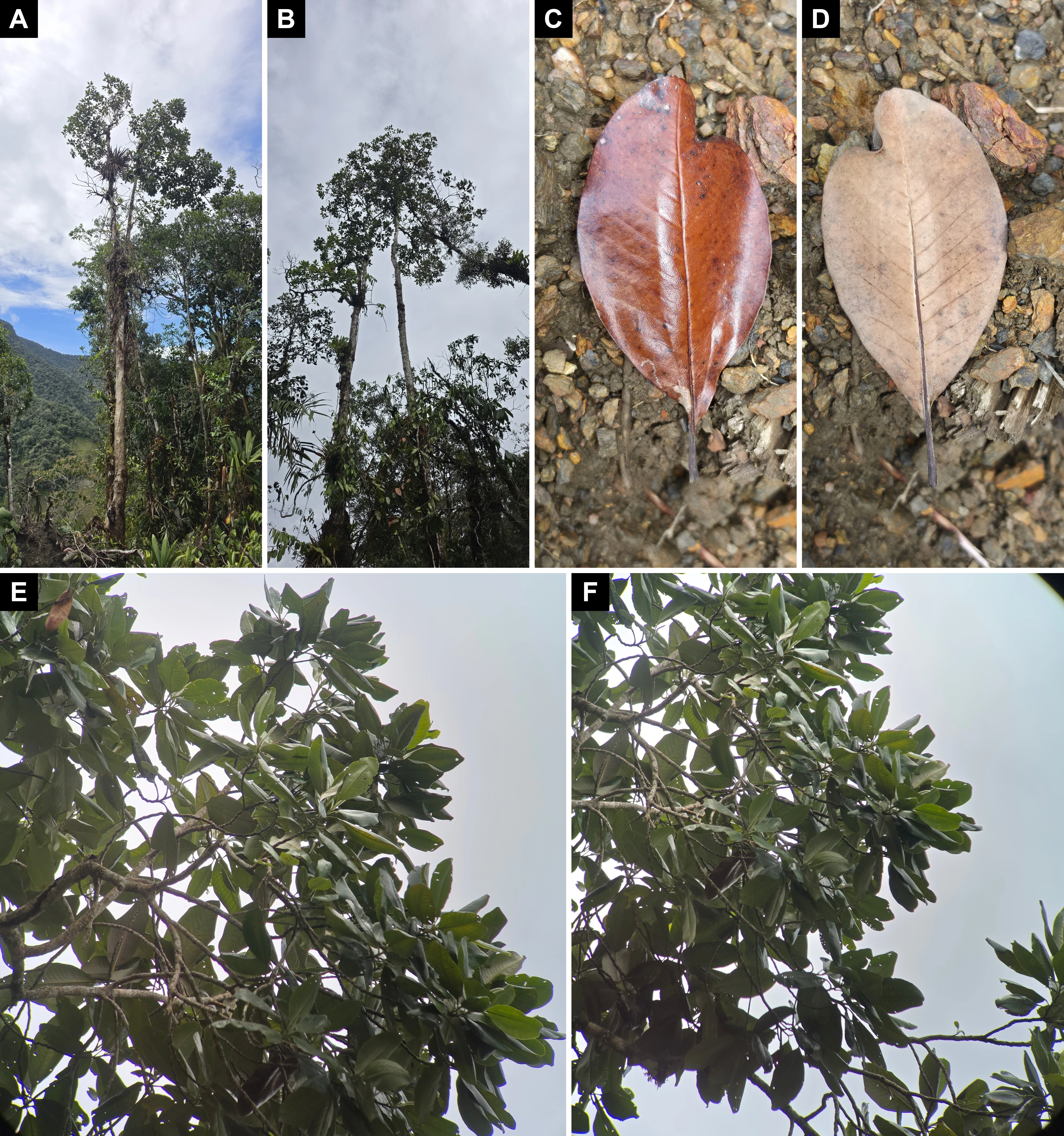
Identification. The trees show the characters used for the La Honda record (Montoya-López, 2025): obovate leaves with evident prefoliation lines and an emarginate apex, a short, appressed, white-cream indumentum covering the abaxial surface, and white woolly stipules (Figure 4).
Remarks. In the northern Antioquia populations, the stipules and the petioles of young leaves lack a white woolly indumentum. The type locality and La Honda populations have it (Montoya-López, 2025). The Río Verde trees also have white woolly stipules, so they belong to the eastern form. The locality is about 11 km south-southeast of the La Honda record, at a similar elevation (1,881 vs. 1,865 m a.s.l.), and within the known elevation range of the species, about 1,750–2,500 m (Calderón et al., 2007; Montoya-López, 2025).
The forest
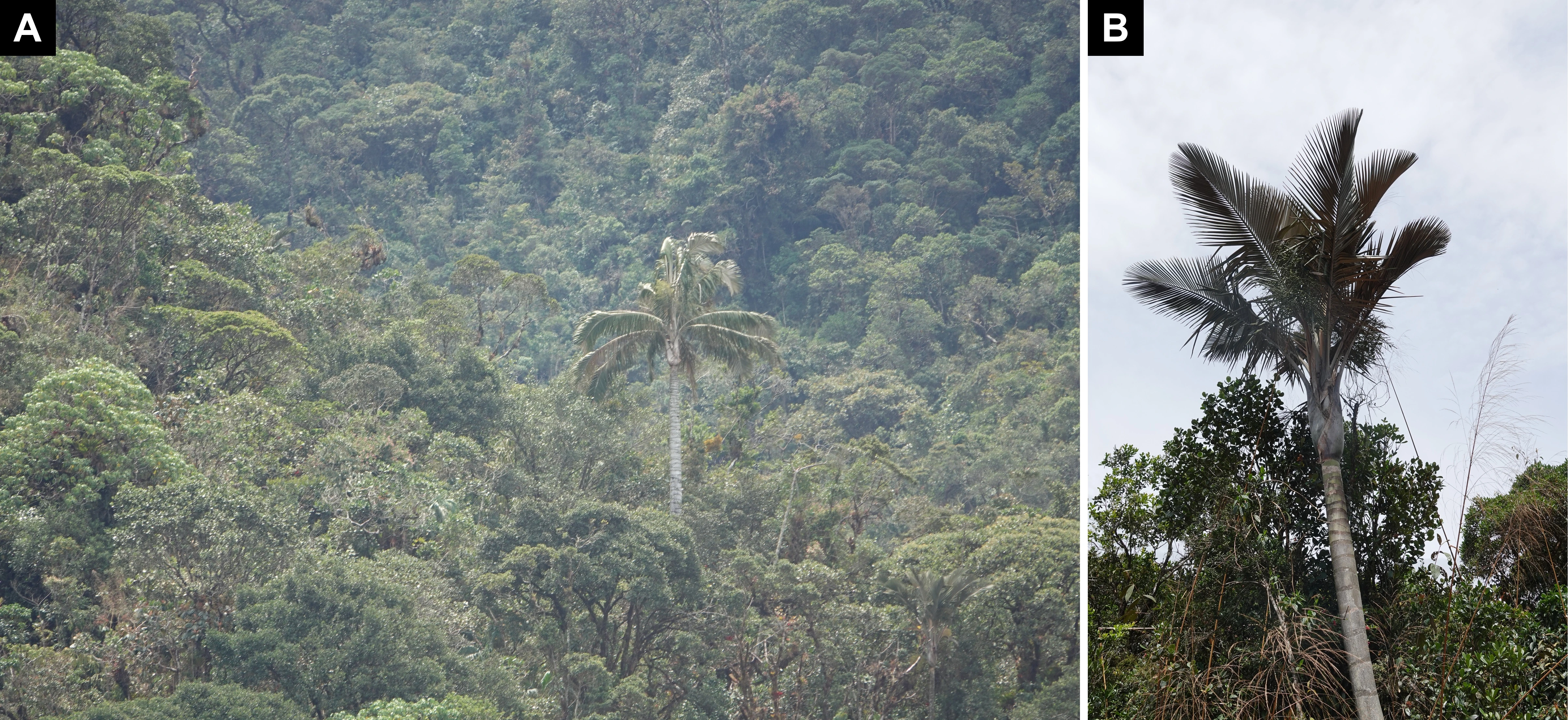
The two records are about 4 km apart but 800 m apart in elevation. Species composition changes markedly along this gradient. The upper section, where M. unicarmensis grows, also holds two wax palms of conservation interest: Ceroxylon quindiuense and C. parvifrons (Figure 5). Along the whole road the forest is rich in Clusia, with oaks (Quercus humboldtii) and scattered Podocarpus oleifolius.
The fragment is extensive and well connected. That matters here because M. guatapensis is restricted to fragmented forest and threatened by habitat conversion (Calderón et al., 2016; Montoya-López, 2025). Here, both magnolias occur in forest that is still continuous with the La Honda forest, not in isolated remnants.
Why the connection matters
Both species were thought to stop at La Honda. This is most likely a result of where botanists had looked, not a real range limit. For M. unicarmensis it was also a matter of names: the 1988 collection from the La Unión–Sonsón road sat in a herbarium under another species until 2023. The Río Verde records extend the southern limit of each species along the same montane forest belt of the Central Cordillera. They also suggest that more of this forest, south of La Honda and away from roads, may hold further populations.
The records bear directly on the conservation assessment of M. unicarmensis. It was proposed as Critically Endangered under criterion B1ab(i,ii,iii,v), because its estimated extent of occurrence was below 100 km² (Montoya-López & Bota-Sierra, 2023; IUCN, 2012). The Río Verde record, 14 km from the type locality, and the 1988 specimen both fall outside the area on which that estimate was based. The extent of occurrence and area of occupancy of both species should be recalculated with these records.
No herbarium vouchers were deposited. Collecting them from the Río Verde populations remains a priority, both to document the locality in a herbarium and to compare the reproductive structures of these trees with the populations to the north.
North and south of Cerro de Las Palomas
Until now there was no documented record of a native magnolia for the municipality of Sonsón. None appears among the 1,977 Colombian Magnoliaceae records in GBIF, in the red book of Colombian magnolias, or in the papers that set out the ranges of these two species (Calderón et al., 2007; Montoya-López & Bota-Sierra, 2023; Montoya-López, 2025; GBIF.org, 2026). With the Río Verde records and the 1988 specimen, M. unicarmensis and M. guatapensis are now documented, between them, in La Unión, El Carmen de Viboral and Sonsón, in the forests north of Cerro de Las Palomas (3,340 m), one of the summits of the Sonsón páramo (CORNARE, 2021; Figure 1).
All the magnolias recorded in these forests belong to subsection Dugandiodendron of section Talauma (Figlar & Nooteboom, 2004). Magnolia unicarmensis was described in it, and M. guatapensis was first described as Dugandiodendron guatapense (Lozano-Contreras, 1994; Montoya-López & Bota-Sierra, 2023). No species of subsection Talauma has turned up there, either in our fieldwork or in GBIF. The absence stands out because the type locality of Magnolia espinalii (Lozano) Govaerts, a Critically Endangered species of that subsection (MADS, 2024), is close by: Mesopotamia, today a corregimiento of La Unión, 1.5 km toward Abejorral, at 2,350 m (Lozano-Contreras, 1983). It lies about 7 km from the type locality of M. unicarmensis, on the same side of the Río Buey, 11 km from the Río Verde trees and only 3.6 km from the 1988 specimen. The management plan of the DRMI Páramo de Vida Maitamá–Sonsón names M. espinalii among the area's representative species, but it draws on a list of possible species, cites no specimen, and places the species near the páramo rather than in it (CORNARE, 2021).
What grows on the other side of the massif is not known. The summit of Cerro de Las Palomas lies on the divide between the Magdalena and Cauca basins. Its south and south-east slopes drain through Argelia to the Río Samaná Sur, and the municipality of Nariño begins about 4 km to the south; the border with Caldas lies farther south and west. GBIF holds no Magnoliaceae record from Nariño or Argelia, nor from the Caldas municipalities that border Sonsón. The only records from a neighbouring municipality are four observations identified only to genus in the Selva de Florencia National Natural Park, in Samaná, Caldas, which borders Nariño and Argelia, at 1,330–1,376 m (GBIF.org, 2026). This is a gap in sampling, not a documented absence: the main systematic biological survey of the Sonsón páramo complex, in 2014, worked almost entirely above 2,800 m, higher than these magnolias grow (Alzate & Sarrazola, 2025). The forests on the south side, at the elevations where M. unicarmensis and M. guatapensis occur, are the obvious next place to look. They may extend the ranges of these two species again, or hold others.
Acknowledgements
Fieldwork was carried out with Yoshi Orozco and María Josefita Alcibíades (Figure 6).
References
Alzate FA, Sarrazola H, 2025. Estudios bióticos: Plantas, edafofauna epígea, anfibios y aves de los Complejos de Páramos de Sonsón y Urrao. Version 1.1. Instituto de Investigación de Recursos Biológicos Alexander von Humboldt. Occurrence dataset. https://doi.org/10.15472/wiu5hg
Calderón E, Cogollo Á, Velásquez-Rúa C, Serna-González M, García N, 2007. Las magnoliáceas. Pp. 45–154 in: García N (Ed.), Libro Rojo de Plantas de Colombia. Volumen 5: Las magnoliáceas, las miristicáceas y las podocarpáceas. Serie Libros Rojos de Especies Amenazadas de Colombia. Instituto Alexander von Humboldt, CORANTIOQUIA, Jardín Botánico Joaquín Antonio Uribe de Medellín, Instituto de Ciencias Naturales de la Universidad Nacional de Colombia, Ministerio de Ambiente, Vivienda y Desarrollo Territorial, Bogotá.
Calderon E, Cogollo A, Velasquez-Rua C, Serna-Gonzalez M, Garcia N, Rivers M, 2016. Magnolia guatapensis. The IUCN Red List of Threatened Species. https://doi.org/10.2305/IUCN.UK.2016-1.RLTS.T38859A2884248.en
CORNARE [Corporación Autónoma Regional de las Cuencas de los Ríos Negro y Nare], 2021. Plan de Manejo del Distrito Regional de Manejo Integrado Páramo de Vida Maitamá–Sonsón. CORNARE, El Santuario, Antioquia. https://www.cornare.gov.co/SIAR/Plan-de-manejo/DRMI-Paramo-de-Vida-Maitama-Sonson/Plan-de-Manejo-DRMI-Paramo-de-Vida-Maitama-Sonson.pdf
Figlar RB, Nooteboom HP, 2004. Notes on Magnoliaceae IV. Blumea 49: 87–100. https://doi.org/10.3767/000651904X486214
GBIF.org, 2026. GBIF occurrence search: Magnoliaceae, Colombia. https://www.gbif.org/occurrence/search?taxon_key=4690&country=CO (accessed 28 September 2026).
HUA [Herbario Universidad de Antioquia], 2026. Specimen database: HUA 59393, J. Zarucchi 7275. Universidad de Antioquia, Medellín (accessed 28 September 2026).
IUCN, 2012. IUCN Red List Categories and Criteria: Version 3.1. Second edition. IUCN, Gland, Switzerland and Cambridge, UK.
Lozano-Contreras G, 1983. Magnoliaceae. Flora de Colombia 1. Instituto de Ciencias Naturales, Universidad Nacional de Colombia, Bogotá.
Lozano-Contreras G, 1994. Dugandiodendron y Talauma en el Neotrópico. Colección Jorge Álvarez Lleras No. 3. Academia Colombiana de Ciencias Exactas, Físicas y Naturales, Bogotá.
MADS [Ministerio de Ambiente y Desarrollo Sostenible], 2024. Resolución 0126 del 6 de febrero de 2024, por la cual se establece el listado oficial de las especies silvestres amenazadas de la diversidad biológica colombiana continental y marino costera, se actualiza el Comité Coordinador de Categorización de las Especies Silvestres Amenazadas en el territorio nacional y se dictan otras disposiciones. Bogotá.
Montoya-López A, 2025. Hidden in the Andes: new insights into the distribution of Magnolia guatapensis (Lozano) Govaerts (Magnoliaceae) and Cyathea antioquensis A. Rojas (Cyatheaceae). Check List 21 (4): 658–665. https://doi.org/10.15560/21.4.658
Montoya-López AF, Bota-Sierra CA, 2023. Magnolia unicarmensis (Magnolia subsect. Dugandiodendron; Magnoliaceae): a new species from tropical montane forests of Antioquia, Colombia. Phytotaxa 626: 41–50. https://doi.org/10.11646/phytotaxa.626.1.5